The City of Charlottetown has released the draft Zoning and Development Bylaw for public review. Public engagement on the draft bylaw has been underway since spring 2025 and has resulted in important resident feedback and refinement of the proposed bylaw to ensure it reflects the priorities of the community.
The new bylaw proposes several changes aimed at making development rules clearer and the approval process more predictable. It also proposes new regulations to support more housing choice in existing neighbourhoods through gentle density and Accessory Dwelling Units.
Some of the key changes include:
Simplified zoning: A clearer zoning structure that is easier to understand and administer.
Clearer development pathways: More clarity on which projects are permitted as-of-right or require site plan approval or a development agreement.
Updated parking requirements: Reduced or eliminated parking minimums in some areas with access to transit and active transportation options.
Streamlined development: Clearer standards for the size and form of buildings, reducing the need for subjective review.
More opportunities for ADUs: Updated Accessory Dwelling Unit (ADU) rules that can gently increase density in existing neighbourhoods and reduce the need for rezonings for small-scale housing additions.
Administrative variances: Some minor technical changes could be approved by staff rather than requiring a Council decision.
Environmental and flood risk considerations: Mapping would help identify environmental constraints and potential risks earlier in the development process.
What’s Next?
Members of the public will have a final opportunity to have their say on the draft bylaw at a Public Meeting of Council on Thursday, September 3, 2026, at 7 p.m. at the Rodd Charlottetown Hotel (75 Kent Street). This meeting is an opportunity for any member of the public to speak directly to City Council and have their comments entered into the public record. Please note that all speakers will have a maximum of 5 minutes for comments.
Following the public meeting, a Planning Board Meeting will be held in early October to present the findings of the public meeting, consider any recommended revisions, and make a final recommendation to City Council. Council will then consider the bylaw for adoption at a Regular Meeting of Council.
How to Participate
There are three ways to participate in the upcoming Public Meeting:
In-person (no registration required)
Virtually (registration required)
To register, please send your name, contact number and/or email address to the Planning and Heritage Department at planning@charlottetown.ca or by calling 902-629-4158 during business hours (8 a.m. – 4p.m., Monday-Friday). The deadline for registration is Tuesday, Sept. 1. Registered participants will receive an update from staff with instructions on how to participate in the meeting virtually no later than 12 noon on Sept. 2.
Hand-delivering comments to the Planning and Heritage Department, located at 70 Kent Street in Charlottetown.
Please note that all comments received will become part of the public record.
Important Documents
The following documents can be found under the ‘documents’ section of this page.
Draft Zoning and Development Bylaw
Draft Updated Zoning Map
Planning Board Presentation – Aug. 5, 2026 *This presentation provides an overview of the Zoning and Development Bylaw update, how it implements the City’s planning direction, what has changed from the current regulation, and how community input shaped the draft bylaw.
What We Heard Report – July 28, 2025
Planning Board and Design Review Board – Terms of Reference
Development Pathways Checklist
Current Zoning and Development Bylaw (2018)
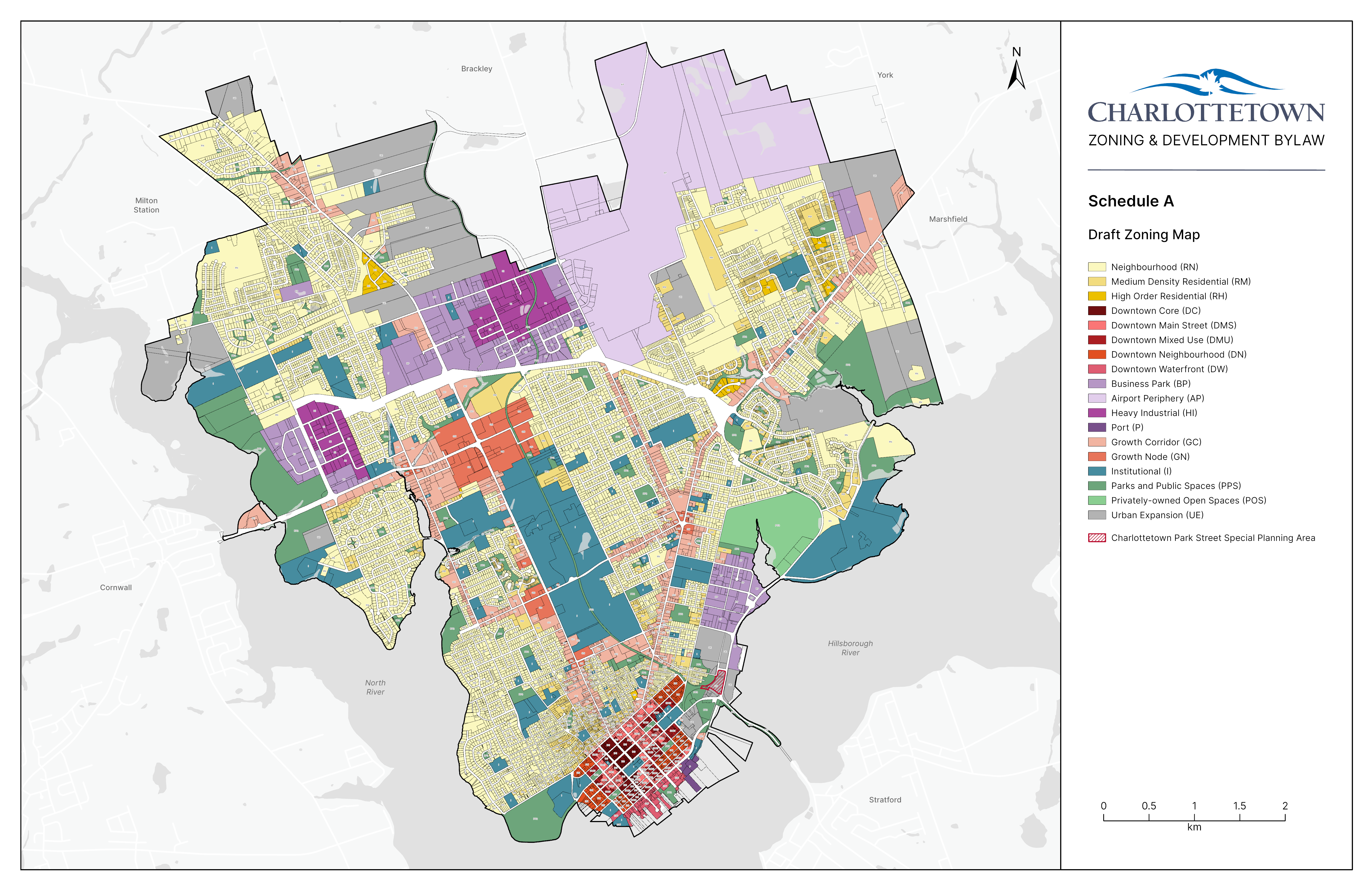
Proposed Zoning Map
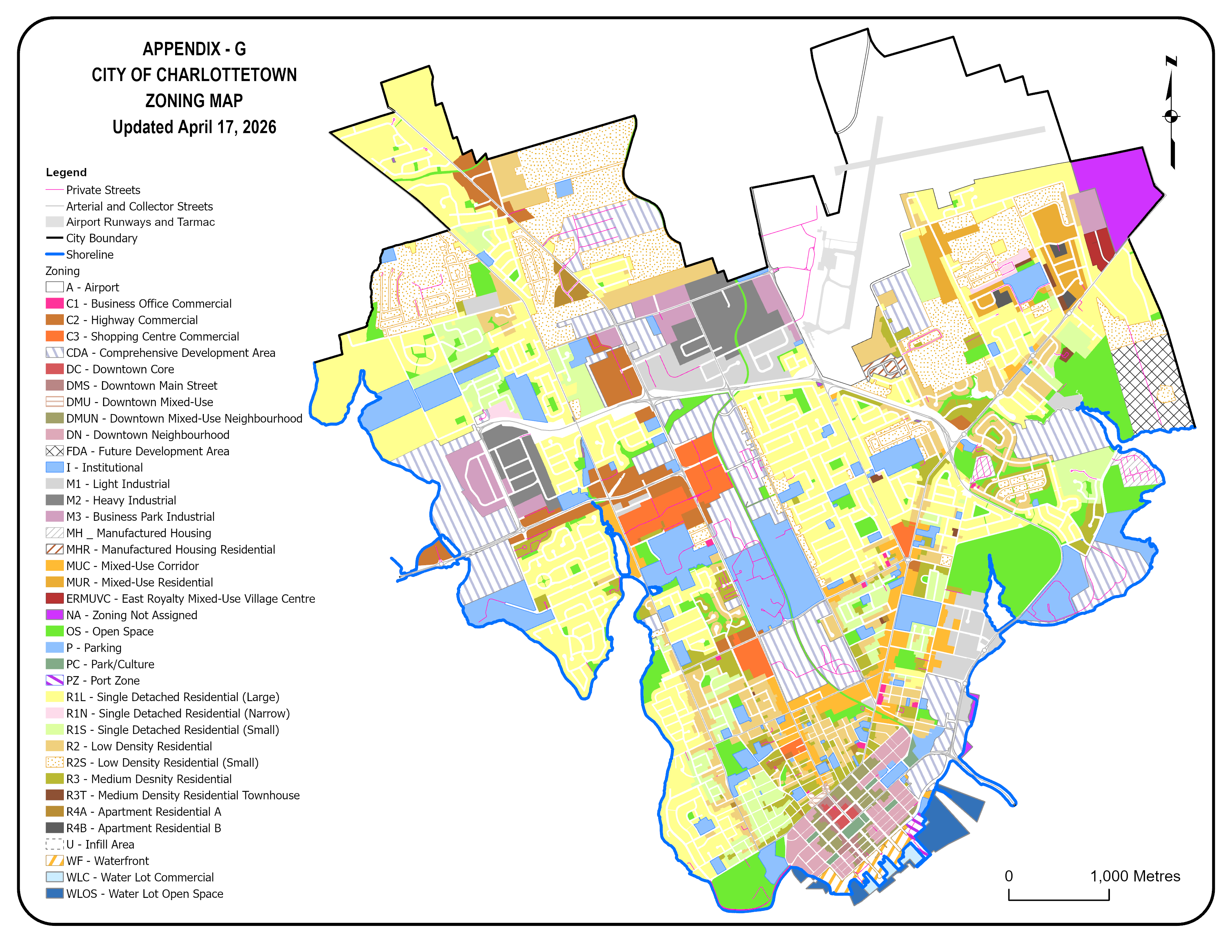
Current Zoning Map
The City of Charlottetown has released the draft Zoning and Development Bylaw for public review. Public engagement on the draft bylaw has been underway since spring 2025 and has resulted in important resident feedback and refinement of the proposed bylaw to ensure it reflects the priorities of the community.
The new bylaw proposes several changes aimed at making development rules clearer and the approval process more predictable. It also proposes new regulations to support more housing choice in existing neighbourhoods through gentle density and Accessory Dwelling Units.
Some of the key changes include:
Simplified zoning: A clearer zoning structure that is easier to understand and administer.
Clearer development pathways: More clarity on which projects are permitted as-of-right or require site plan approval or a development agreement.
Updated parking requirements: Reduced or eliminated parking minimums in some areas with access to transit and active transportation options.
Streamlined development: Clearer standards for the size and form of buildings, reducing the need for subjective review.
More opportunities for ADUs: Updated Accessory Dwelling Unit (ADU) rules that can gently increase density in existing neighbourhoods and reduce the need for rezonings for small-scale housing additions.
Administrative variances: Some minor technical changes could be approved by staff rather than requiring a Council decision.
Environmental and flood risk considerations: Mapping would help identify environmental constraints and potential risks earlier in the development process.
What’s Next?
Members of the public will have a final opportunity to have their say on the draft bylaw at a Public Meeting of Council on Thursday, September 3, 2026, at 7 p.m. at the Rodd Charlottetown Hotel (75 Kent Street). This meeting is an opportunity for any member of the public to speak directly to City Council and have their comments entered into the public record. Please note that all speakers will have a maximum of 5 minutes for comments.
Following the public meeting, a Planning Board Meeting will be held in early October to present the findings of the public meeting, consider any recommended revisions, and make a final recommendation to City Council. Council will then consider the bylaw for adoption at a Regular Meeting of Council.
How to Participate
There are three ways to participate in the upcoming Public Meeting:
In-person (no registration required)
Virtually (registration required)
To register, please send your name, contact number and/or email address to the Planning and Heritage Department at planning@charlottetown.ca or by calling 902-629-4158 during business hours (8 a.m. – 4p.m., Monday-Friday). The deadline for registration is Tuesday, Sept. 1. Registered participants will receive an update from staff with instructions on how to participate in the meeting virtually no later than 12 noon on Sept. 2.
Hand-delivering comments to the Planning and Heritage Department, located at 70 Kent Street in Charlottetown.
Please note that all comments received will become part of the public record.
Important Documents
The following documents can be found under the ‘documents’ section of this page.
Draft Zoning and Development Bylaw
Draft Updated Zoning Map
Planning Board Presentation – Aug. 5, 2026 *This presentation provides an overview of the Zoning and Development Bylaw update, how it implements the City’s planning direction, what has changed from the current regulation, and how community input shaped the draft bylaw.
What We Heard Report – July 28, 2025
Planning Board and Design Review Board – Terms of Reference
Note: Online feedback form will close on Friday, September 18 at noon.
The Draft Zoning and Development Bylaw is available in the Documents section of this page. Please review the draft and use this form to share your feedback.
The form is organized by the different 'parts' of the bylaw. Please submit your comments under the part they relate to. If possible, include the page number you are commenting on. This will help us understand and review your feedback.
If your comments do not relate to a specific part of the bylaw, please use the General Feedback section at the end of the form.
Example: If you have feedback about residential neighbourhood zones, submit it under Part 11 – RN – Residential Neighbourhood. For comments about the bylaw as a whole, use the General Feedback section at the end of the form.